The Ultimate Guide to Crepe Paper

Everything I have learned about the paper that started it all.
If you make paper flowers, or you are about to, this is the page I would hand you first.
Crepe paper is the heart of nearly everything we do, and after years at the worktable, I have a lot to say about it: what it is, why it behaves the way it does, the three kinds we make and where each one belongs, and how to choose the right color without guessing from a screen. Settle in. This is the whole picture in one place.
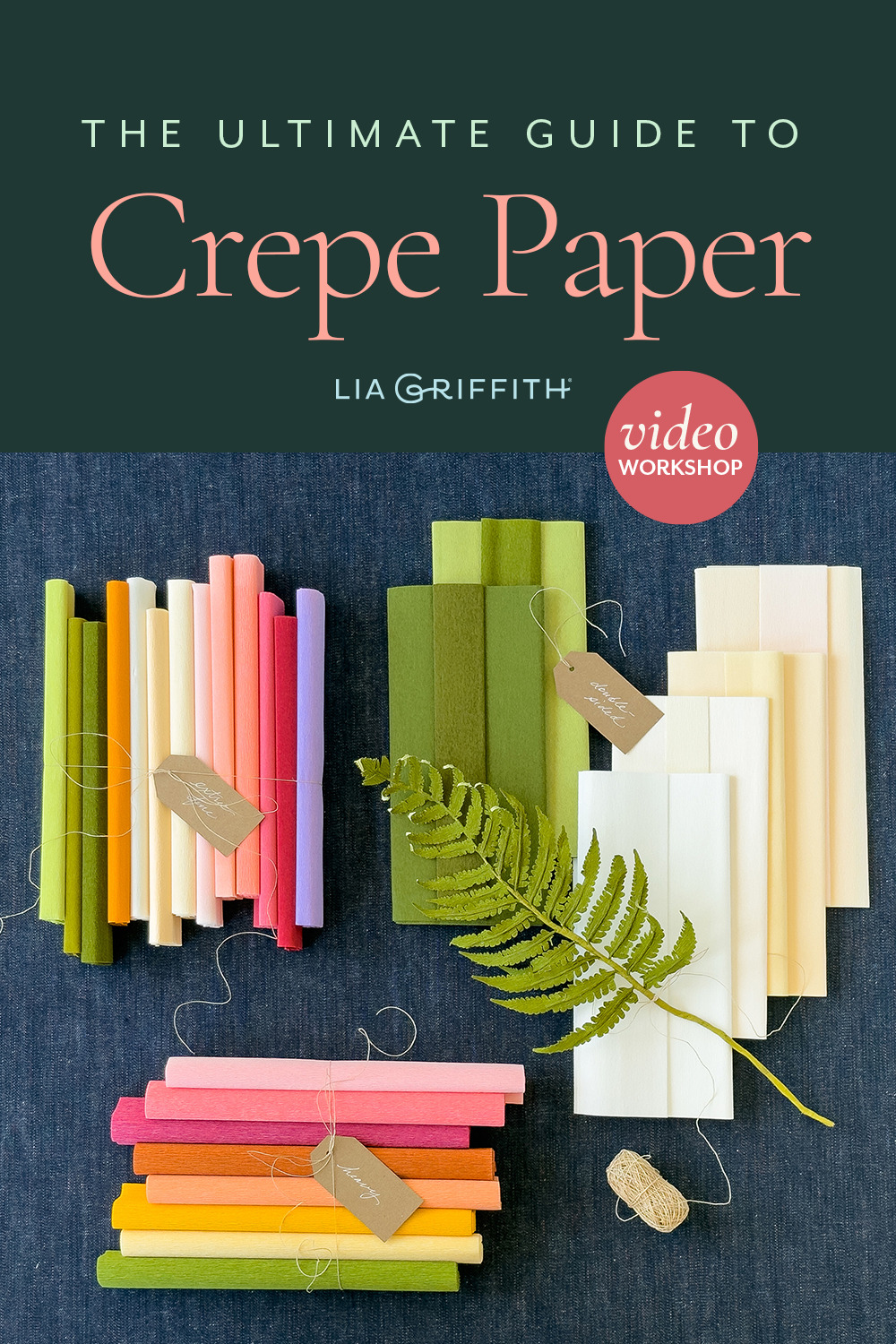
What to know about crepe paper
It is an old, lovely craft. Crepe paper has been in our hands for more than a century. In the early 1900s it became the first real stand-in for fresh flowers, a craft passed from mothers to daughters, history folded into every petal. We are in a quiet renaissance of it now, led by thoughtful crafters like you. Today two makers set the standard for craft-grade crepe: Cartotecnica Rossi in Italy and Werola in Germany.
The grain is the secret. Those fine, crinkled lines running through the paper are the grain, and they are what make crepe so unlike any other paper. The grain is what lets it stretch, cup, and curl. When you cut along it, your petals come alive with movement. You will learn to read it as you go, and before long your hands will know it without being told.
Not all crepe is the same. Chinese and American crepe papers are lighter with less stretch, fine for bright party decor and a gentle first try. Italian crepe from Cartotecnica Rossi is bespoke and beautiful, sold in long rolls with visible machine lines that give it character. German crepe from Werola is handcrafted and smoother, and Werola is the maker celebrated for that velvety double-sided crepe. We partnered with Werola about a decade ago to create the Lia Griffith line, built specifically for flower making, in three types: extra-fine, heavy, and double-sided.
Stretch matters more than weight. This one trips people up. Weight in grams is how some papers are measured, but our German papers come in different roll sizes, so a gram number tells you very little. What actually matters is how the paper performs in your hands, and the truest measure of that is stretch. So when you are choosing, think about stretch and feel, not weight.
The three crepes, and where each one lives now
We chose three papers on purpose, because together they give us the full range of what a real flower needs. We often use all three in a single bloom.
Heavy crepe
The sturdy one. With around 250% stretch and a thicker, pronounced texture, heavy crepe holds its shape and is forgiving to work with, which is exactly why it is also our friendliest paper for beginners. It is the one to reach for when a flower is large or sculptural, and it is strong enough to hold a fine fringe for stamen centers.
Best for: big blooms, bold shaping, leaves, fringed centers, and first tries.
Extra-fine crepe
The soft, delicate one, light and almost fabric-like, with a translucent quality that catches the light the way a real petal does. It is lovely on its own for fine, detailed petals. But here is the honest truth of how we work now: we rarely use it alone anymore. More often, extra-fine is the building block, the paper we fuse together to make double-sided.
Best for: delicate petals, detailed work, and as the base for double-sided crepe.
Double-sided crepe
The paper we reach for most these days. Two coordinating colors are bonded into one velvety sheet, so your flowers gain a quiet depth, a lighter shade inside the petal and a deeper one on the back. It has less stretch than the others because it is layered, which actually makes it ideal for flatter or larger petals, leaves, and foliage that need to hold their form. And you are never limited to the pairings on the shelf, because you can fuse two extra-fine colors into your own custom sheet with a little fusible web.
Best for: lifelike depth, flatter and larger petals, leaves, and custom color pairings.
Your free crepe paper swatch guide
Here is the thing no screen can ever get right: color. Crepe has a softness and a depth that a photo flattens every time.
So we made you something better than a chart. Print our three swatch sheets, one for extra-fine, one for heavy, one for double-sided, then snip a small piece of each real color and glue it into its labeled spot. When you are done, you have a true reference you can see and feel, made from the actual paper, to keep beside your worktable for good.
It is a lovely little project in itself, and it takes the guesswork out of every order you place after.
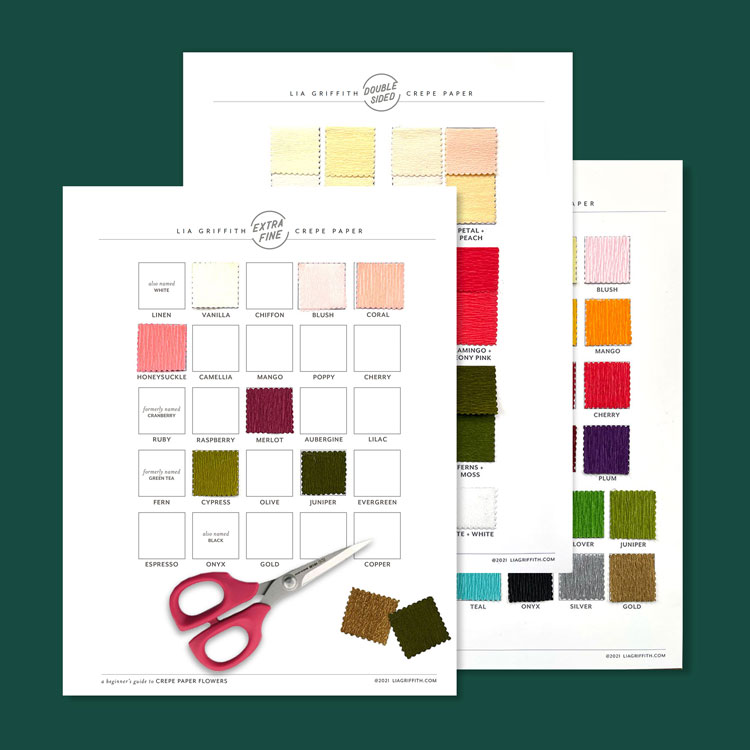
Where to find every color
You will find the complete collection of Lia Griffith crepe paper in our shop, Felt Paper Scissors. You can buy single colors to build your own palette, or curated packs of ten in both heavy and extra-fine when you want a full range in one place.
A few crepe paper terms
If you are new to all this, a few words come up again and again. Here is what they mean.
Grain — the fine crinkled lines in the paper. Cut along them and your petals move naturally.
Stretch — the give that lets a flat sheet open into a cupped petal. The truest measure of a crepe.
Cupping — gently pushing your thumbs into the center of a petal to shape a natural curve.
Ruffling — pinching and lightly stretching a petal's edge to create that perfect, imperfect flutter.
Fringing — cutting fine strips along the grain, most often for the stamen at a flower's center.
Double-sided (doublette) — two colors fused into a single sheet, with a different shade on each face.
Laminating — fusing two extra-fine sheets together with fusible web to make your own double-sided crepe.
A little more for you
Much of what I know about this paper found its way into our book, Paper Flower Garden. If you would like these techniques in your hands at the worktable, twenty-eight flowers, step by step, it is a lovely companion to everything on this page.
Where to begin
If all of this is new, do not worry about getting it perfect.
Pick up a piece of heavy crepe in a color you love, feel how it stretches, and let the paper teach you. That is how every one of us started.
When you are ready for a little guidance, my free foundation series walks you through crepe paper flowers from the very first petal, at your own pace, with me right beside you.
Start with the free foundation series ›
Happy crafting, ~ Lia
Better Than Pinterest
Become a member and get instant access to a professional collection of 2000+ crafts, 400+ videos, and a growing library of master classes for all skill levels. For less than your daily coffee, you'll learn new skills and techniques, create beautiful handmade projects like this, and join a community of crafters just like you! Spend less time searching, more time crafting. It's better than Pinterest, promise. 😉
Become a Member
Discussion
Ask Lia or the community!
16 Comments
-

Sheena
November 25, 2020 at 3:59pm
-

Lia
November 28, 2020 at 10:56am
@Sheena
-

Joanne
May 4, 2020 at 8:43am
-

Lia
May 6, 2020 at 9:14am
@Joanne
-

Amanda
February 11, 2019 at 7:20am
-

Lia
February 11, 2019 at 8:27am
@Amanda
-

Tammy
August 27, 2018 at 2:07pm
-

Lia
August 27, 2018 at 3:01pm
@Tammy
-

Debra
July 16, 2018 at 3:40pm
-

Lia
July 17, 2018 at 7:57am
@Debra
-

Robyn
May 5, 2018 at 9:33pm
-

Lia
May 7, 2018 at 9:04am
@Robyn
-

Lynn
April 9, 2018 at 5:38am
-

Lia
April 9, 2018 at 8:52am
@Lynn
-

Bridget
April 7, 2018 at 9:07am
-

Lia
April 9, 2018 at 8:57am
@Bridget
Leave a CommentHi I’m totally new to this, how many normal sized flowers roughly can you make with each pack?
Hi Sheena! It definitely depends on the flower, and how close you cut the petals. The more simple (like our Anemone) would yield 12+ blooms, while a peony or full bloom rose may only yield 4-5.
the info tells me how many rolls in each package, but I need to know how large is the sheet of each colour? I want to make huge flowers and need to ensure the size is big enough.
Thanks
Hi Joanne,
The short crepe paper rolls mentioned in this post measure 9.8” x 78.7” per roll. We also have some single long rolls of extra fine crepe paper in our shop that are larger and measure 19.6” x 78.7” each.
I need a burgundy fine crepe paper!!!! I’m making the flowers for my son’s wedding, The fine crepe paper makes such beautiful roses, but I cannot find the right color. I love your designs and I own/have used multiple packs of your paper but I really NEED Burgundy
I wish we had the right color for you! Have you tried using PanPastels to add color?
I have been trying all morning to get the svgs for your two books, Crepe Paper flowers and Cutting Machine crafts to no avail! Could I be sent an email with a short cut to the exact page where I need to enter in the codes for these items. Thank you in advance 🙂
Hi Tammy– the URLs are listed on page 12 of Cutting Machine Crafts, and page 31 of Crepe Paper Flowers. Pay close attention to the URLs and type them exactly as they appear in the book– they’re very specific and different than just liagriffith.com.
Why are you not selling individual color xtra fine crepe paper I just need white, vanilla and coral about 2 or 3 pks each
We would if we could! Retailers didn’t respond well to the idea of single rolls, so we are only able to offer the 10-packs in our new colors for now. We still do have single rolls of our original crepe line– the coral is not as bright, just FYI. https://liagriffith.com/product-category/crepe-paper/extra-fine/
Oh yay. I had actually given up ever seeing Lia Griffith paper over here in Australia. Just had a look at my local Craftonline shop and nearly fell off my chair !!!!!!!!!!!!! There were packets of Lia Griffith paper staring at me. Just did some online retail therapy. I am one happy little vegemite !!!!!!!!!
cheers
Robyn
Yay!! I’m so glad to hear it!!
Love your products and feel they are so reasonably priced. I know you recently partnered with JoAnn’s Fabrics any chance you will start selling the Crepe Paper at the store?
Thank you for the feedback, that’s so wonderful to hear 🙂 We don’t have any plans to sell crepe paper at their store– but you never know 🙂
Hey Lia & Team – love all the new colours and your tools! Will it be long before they are available in the UK?
Hi Bridget! We really hope so, but Fiskars UK needs to see a demand in order to start selling over there. You could ask your local craft store/Fiskars retailer about it 🙂
Back to the Top