How to Use SVG Files for Cricut

Every project in our library comes with SVG cut files. They can help you create a paper peony in an afternoon instead of a full weekend.
If you are new to your Cricut, importing files into Design Space can feel a bit overwhelming.
This guide walks you through the whole path. Download, unzip, upload, prep, cut. It is current to Design Space as of 2026, so what you read here matches what you see on your screen.
Bookmark it. Come back to it. You will only need it a few times before it becomes muscle memory.
Tools
- Cricut Maker 4 (includes fine point blade)
- Cricut Mats
- Rotary Blade
- Scoring Wheel
- Cricut Brayer
- Curling Tool
- Needle-Nose Tweezers
Materials
- Crepe Paper
- Cardstock
- Frosted Paper
- Wool Blend Felt
- Our Favorite Vinyl
- Painters Tape

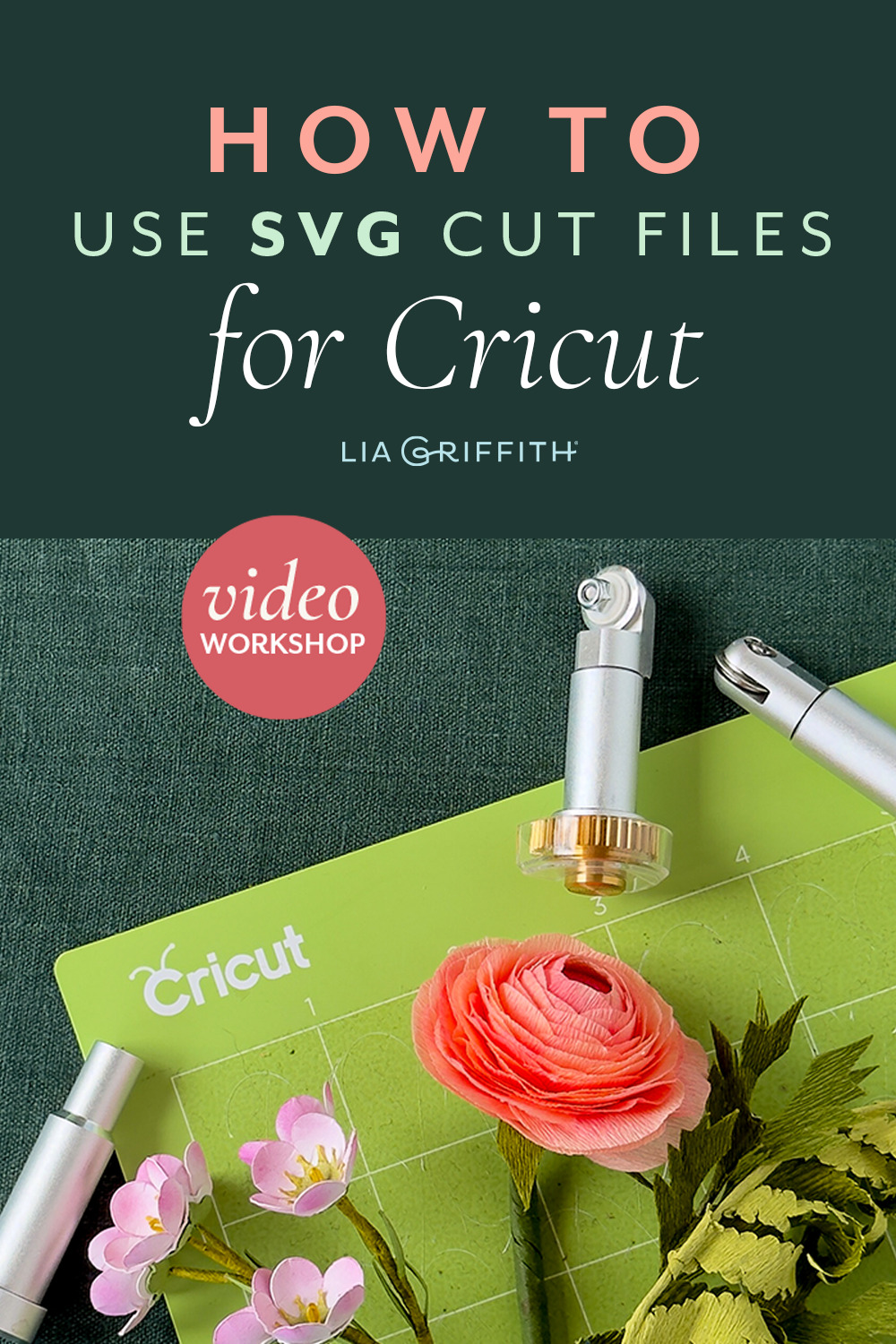
If you would rather watch before you read, this short lesson from our free Cricut Foundation Series covers exactly what we are about to do: finding your file, unzipping it, and getting it into Design Space without the guesswork.
Click here to watch the complete
Cricut Maker Foundation Series
Step 1: Make a Folder First
This takes ten seconds and saves you a great deal of hunting later.
On your desktop, right-click and choose New Folder. Name it something you will recognize. Meagan names hers Project Files.
Every cut file you download from us can live here. When you go looking for a file six months from now, you will be glad it has a home.
Step 2: Download the SVG File
Go to the project you would like to cut. Find the download button and click it. That brings you down the page to all of the project downloads.
From here, you have two choices. Download All gives you all files for the project in a single zipped folder. Cutting Machine Template provides only the SVG cut file, which is the one your machine uses.
A window opens asking where to save. Navigate to the folder you made in Step 1, double-click it, and click Save. You can rename the file here if you like.
What lands in your folder is a compressed folder, also called a zip file. Inside it is the actual cut file. This is normal. Most cut file sites work this way, because a zip lets us hand you several files in one click.
Note: if you skip the folder step, most computers save to the Downloads folder.
Step 3: Unzip the Folder
This is the step that trips up the most crafters, so take your time here.
Design Space cannot read a file that is still inside a zip folder. If you try, you get an error saying the file is not supported. Nine times out of ten, that error means the folder was never unzipped.
On a Mac
Double-click the zip folder. It expands in the same place, and the new file appears right beside the original. Look for the file ending in .svg.
On Windows
Right-click the zip folder and choose Extract All. It will offer to unzip to the same location, or you can click Browse to pick a different location. Check the box for Show extracted files when complete, then click Extract.
On iPad or iPhone
Open the Files app and find your download. Tap the zip folder once. iOS expands it into a folder beside the original. Open it to find the .svg file.
On Android
Open the Files app, find the zip, and tap Extract.
Once it has unzipped, select the zip folder and move it to the trash. You do not need it anymore, and keeping it around is how crafters end up uploading the wrong one.
Before you move on, confirm you are looking at a file that ends in .svg. Not .zip. Not .png. The extension matters.
Step 4: Upload the File into Design Space
Open Design Space and click New Project in the upper right corner. Click Blank Canvas, then Start Designing.
- Click Upload in the left panel.
- Click Upload Image.
- Click Browse to find your unzipped .svg file. Select the project folder you created, then the file you would like to cut.
- Design Space shows you a preview. Because SVG files already contain cut paths, there is nothing to trace and no background to remove. If Design Space asks you to clean up the image, you selected a PNG or JPEG by mistake. Go back and pick the .svg.
- If the preview looks correct, click Continue.
- Click Upload in the bottom right corner.
Your file is now on your canvas.
Design Space accepts one SVG at a time. If a project has several files, repeat the upload for each one.
Step 5: Get Your Canvas in Order
Two small housekeeping moves make everything after this clearer.
Close the sidebar that pops out on the left. Click the little arrow to tuck it away and give yourself room. Then zoom out until you can see everything on the canvas at once.
Do not resize the design. Our files are already scaled to match the project photos. A peony petal cut at 80 percent will not assemble into the flower you saw. Resize only when you want a deliberately larger or smaller version.
Now look at the layers panel on the right. Everything arrived grouped. Click the little arrow next to the Group button to expand it and see all your groups.
You are not ungrouping here. You are opening the list to see what you are working with.
Step 6: Hide the Designer Notes Layer
Every file from our site includes a layer of designer notes at the top of the panel. It holds the copyright line, and often the details that make a project work: which direction the crepe paper grain should run, which blade to load, which material setting we used.
Read it. Then hide it.
Click the eye icon next to that layer in the layers panel to turn it off.
This one matters more than it sounds. Those notes sit outside the cut area, so Design Space measures them as part of the design. If you have ever seen the message that a file is too large for your mat, the notes layer is almost always why. Hide it, and the size problem disappears.
Step 7: Attach Each Color Group
This is the most important step in the whole process, and it is the one crafters skip.
We group every file by color and deliberately arrange the pieces to use as little crepe paper as possible. That arrangement is doing real work for you. Attaching is how you keep it.
- Go to the Layers panel and select one color group. A green box appears around it on the canvas.
- Click the little paper clip at the bottom that says Attach.
- Repeat for every color group in the file.
Do not skip any of them.
Here is what happens if you do. Design Space rearranges the pieces on its own. Your layout can stretch past the 10-inch mark, which is the height of a roll of our crepe paper, and pieces end up hanging off the edge of your material. You also use far more crepe than the project needs. And Design Space may rotate pieces, which breaks the grain line direction the designer notes just told you about.
Attaching prevents all of it.
One more thing: do not rotate anything yourself. The pieces are positioned the way they are on purpose, for the grain.
If you need to undo it later, select the set and click Detach.
If Your Project Has Score Lines
Score lines are the solid lines in a file that tell your machine to crease rather than cut. They give you clean folds on boxes, cards, and folded petals.
Design Space cannot tell on its own that a line in an uploaded file is meant to be scored. You set that yourself.
- Click the layer you want to score. It turns dark in the layers panel.
- Go to the Operation dropdown in the edit bar along the top of the screen. It will currently read Basic Cut.
- Choose Score.
The line turns dashed on your canvas, and the layers panel updates to read Score. Repeat for each score layer in the file.
Then attach the score layer to the cut layer it belongs to. Select the score layer, hold Shift, select the cut layer, and click Attach. Without this, your machine scores the lines somewhere off on their own piece of paper, nowhere near the shape they belong to.
If Score is not in your Operation list, check the machine you have selected at the top of the screen. Design Space only shows the operations your model supports.
This step used to live behind a scissor icon and a Layer Attributes panel. Cricut moved it to the Operation dropdown, so older tutorials will point you to a page that no longer exists.
Step 8: Make It
Click Make.
Design Space will ask if you would like to save the project. Say yes. Saving keeps everything you attached and grouped, so if you come back to this project in a year, it is ready to cut with no setup at all. Click Save, name your project, choose the collection you want to save it to, then click Save again.
Now you land on the mat preview. What you see here is exactly what your machine will cut, so this is where you make adjustments.
Check your layout. If you attached your groups, the arrangement should look the way we set it up. Click a shape to select it if you need to move it, or use the three dots at the top left to move it to a different mat or hide it.
Change your material size. Use the dropdown on the left. We often switch to 8.5 x 11-inch text weight paper.
Cut multiples. Enter the number in the top-left corner and click Apply—every mat updates.
Mirror. Turn this on only for iron-on vinyl. Leave it off for paper, cardstock, felt, and crepe.
When your mats look right, click Continue.
Step 9: Choose Your Material Setting
Select the material from the dropdown in Design Space. The designer notes told you which one we used.
If you are on an Explore 3, 4, or 5, there is no dial on your machine anymore. Cricut moved material selection fully into the software. Older Explore models still have the physical dial, and setting it to Custom lets Design Space take over.
Do a test cut on a scrap before you commit a full sheet. If the blade does not get all the way through, use the More Pressure option rather than jumping to a heavier material setting. More Pressure adjusts the cut without changing how the machine handles the material.
Then follow the prompts to load your tools and mats.
Cutting Crepe Paper on a Cricut Maker
Crepe paper deserves its own section, because it does not behave like anything else you will cut.
- Crepe paper cuts on the Cricut Maker family only. The rotary blade is what makes it possible, and it is a Maker tool.
- Use the rotary blade. The fine point blade will drag and tear the fibers.
- Use the pink fabric mat. It grips crepe without pulling it out of shape.
- Watch your grain direction. The lines in crepe run one way, and our designer notes layer tells you which way to lay the sheet so petals cup and stretch correctly. Cut a petal against the grain, and it will not shape.
- Know your dimensions. Our crepe paper is 10 inches tall and comes on a roll, so you can cut whatever width you need, up to the 12-inch width of your mat. That 10-inch height is the measurement to watch on your canvas because it is the one you cannot change.
When you choose the crepe paper setting, Design Space should automatically prompt you for the rotary blade; if it does not, select Edit Tools and choose it yourself.
Which Cricut Machines Work with Our Files
Any Cricut that runs Design Space can open our SVG files. What differs is what each machine can do with them.
Cricut Maker 4 and Maker 3 cut everything we design, including crepe paper, felt, and fabric. If paper flowers are your reason for owning a machine, this is the family to be in.
Cricut Explore 5, Explore 4, Explore 3, and Explore Air 2 handle cardstock, text weight paper, vinyl, and iron-on beautifully. They do not take the rotary blade, so crepe paper is out.
Cricut Venture cuts wide format and is built for batch work.
Cricut Joy: We do not test our files on the Cricut Joy family, so we cannot say how they perform on it. Those machines cut narrower than a standard mat, so check a project's dimensions against your machine before you begin.
Cricut Expression, Cricut Mini, and other pre-Design Space machines cannot use SVG files. They run older software that never supported the format.
Silhouette and Brother ScanNCut users can generally import our SVG files as well. We design and test on Cricut, so we cannot walk you through those interfaces, but the files themselves are a standard format.
Common Questions
Design Space says my file is not supported. What happened? Your file is almost certainly still zipped. Go back and unzip the folder first, then upload the file ending in .svg.
Why does it say my file is too large for the mat? The designer notes layer is being counted in the measurement. Hide that layer with the eye icon, and the size will correct itself.
Design Space rearranged all of my pieces. Why? The color groups were not attached. Go back to the canvas, select each group, then click Attach before clicking Make.
My pieces came out rotated on the mat. Unattached groups allow Design Space to rotate pieces, which runs counter to the grain. Attach every group, and do not rotate anything yourself.
My machine cut the score lines instead of scoring them. The Operation was still set to Basic Cut. Select the layer, open the Operation dropdown, and choose Score.
My machine scored in the wrong place. The score layer was not attached. Select both the score layer and its cut layer, then click Attach before you click Make.
Can I upload several SVG files at once? No. Design Space takes one at a time.
Do I need Cricut Access to use your files? No. Cricut Access is a Cricut subscription that includes access to their image library. Uploading your own SVG files is free.
I bought one of Lia's books. Where are my files? Each book has its own download page and a code printed inside. Cutting Machine Crafts lists it on page 12. Crepe Paper Flowers lists it on page 31. And Paper Flower Garden has a QR code. You do not need a membership to download book files.
Prefer to Watch?
Reading through steps is one thing. Watching someone do it is another.
We have recently released our new Cricut Maker Foundation Series in Craft Academy, which shows you all the steps from downloading our files to setting the cut settings for all the different materials. This is available for everyone to view and learn.
More to Explore
Plenty of places will teach you how to operate your Cricut. We are more interested in what you make with it.
Most of our projects include SVG cut files for Cricut and Silhouette machines. Browse the full SVG cut file library to see what you could be making this weekend. Or explore paper flowers, felt crafts, and cutting machine crafts by category.
Membership opens access to the full library of project tutorials, including pattern downloads, written instructions, and video workshops. Join our community of crafters and start making.
Your Cricut, start to finish
Three things worth having open when you sit down at your machine.
See what your machine can make
More than fifty projects beyond vinyl, from cardstock flowers to felt to crepe paper.
Know your settings
Our printable chart with blade, setting and pressure for every material we cut.
Better Than Pinterest
Become a member and get instant access to a professional collection of 2000+ crafts, 400+ videos, and a growing library of master classes for all skill levels. For less than your daily coffee, you'll learn new skills and techniques, create beautiful handmade projects like this, and join a community of crafters just like you! Spend less time searching, more time crafting. It's better than Pinterest, promise. 😉
Become a Member
Discussion
Ask Lia or the community!
71 Comments
-

Ana
October 12, 2026 at 1:41pm
-

Lia
October 12, 2026 at 1:54pm
@Ana
-

Alejandra
August 13, 2026 at 8:09am
-

Lia
August 13, 2026 at 11:11am
@Alejandra
-

Alejandra
August 18, 2026 at 7:08am
@Lia
-

Lia
August 18, 2026 at 7:42am
@Alejandra
-

Sacha
March 28, 2025 at 4:12am
-

Lia
March 28, 2025 at 10:00am
@Sacha
-

Margarita
February 7, 2025 at 5:25pm
-

Lia
February 10, 2025 at 9:42am
@Margarita
-

Sarah
March 30, 2023 at 10:55am
-

Lia
March 30, 2023 at 1:28pm
@Sarah
-

elizabeth
December 2, 2021 at 7:23am
-

Lia
December 2, 2021 at 7:43am
@elizabeth
-

Judy
March 9, 2021 at 8:49am
-

Lia
March 9, 2021 at 9:15am
@Judy
-

Katrina
May 27, 2020 at 5:00pm
-

Lia
May 29, 2020 at 5:23pm
@Katrina
-

Robin
May 26, 2020 at 7:12pm
-

Lia
May 29, 2020 at 5:25pm
@Robin
-

Anne
April 14, 2020 at 7:37am
-

Lia
April 14, 2020 at 8:31pm
@Anne
-

karsyn
March 16, 2020 at 9:37pm
-

Lia
March 17, 2020 at 10:18am
@karsyn
-

Christine
March 13, 2020 at 7:15pm
-

Lia
March 17, 2020 at 11:26am
@Christine
-

Christine
March 18, 2020 at 6:10pm
@Lia
-

Lia
March 19, 2020 at 1:25pm
@Christine
-

Marlene
November 1, 2019 at 7:27am
-

Lia
November 1, 2019 at 11:02am
@Marlene
-

Nikki
June 28, 2019 at 7:12am
-

Lia
July 1, 2019 at 7:30am
@Nikki
-

Debi
April 18, 2019 at 8:55pm
-

Lia
April 23, 2019 at 9:26am
@Debi
-

Roxyie
April 9, 2019 at 11:18am
-

Lia
April 9, 2019 at 12:14pm
@Roxyie
-

Kathy
March 26, 2019 at 9:22am
-

Lia
March 27, 2019 at 9:14am
@Kathy
-

betty
March 3, 2019 at 12:55pm
-

Lia
March 4, 2019 at 11:11am
@betty
-

Laurie
February 19, 2019 at 7:23am
-

Lia
February 19, 2019 at 8:07am
@Laurie
-

Stacy
February 13, 2019 at 3:50pm
-

Lia
February 14, 2019 at 8:01am
@Stacy
-

holly
February 6, 2019 at 9:45am
-

Lia
February 6, 2019 at 11:54am
@holly
-

Cristina
December 4, 2018 at 2:05pm
-

Lia
December 4, 2018 at 2:59pm
@Cristina
-

Debra
November 9, 2018 at 8:42pm
-

Lia
November 11, 2018 at 12:04pm
@Debra
-

lynette
October 25, 2018 at 1:06am
-

Lia
October 25, 2018 at 8:04am
@lynette
-

Debbie
September 18, 2018 at 8:21pm
-

Lia
September 19, 2018 at 11:09am
@Debbie
-

sara
September 17, 2018 at 11:19am
-

Lia
September 17, 2018 at 12:56pm
@sara
-

Virginie
September 15, 2018 at 9:33am
-

Lia
September 17, 2018 at 7:40am
@Virginie
-

Carla
September 14, 2018 at 8:05am
-

Lia
September 14, 2018 at 9:41am
@Carla
-

Jasmine
August 19, 2018 at 6:01pm
-

Lia
August 19, 2018 at 6:18pm
@Jasmine
-

Henrietta
August 15, 2018 at 5:52pm
-

Lia
August 15, 2018 at 7:58pm
@Henrietta
-

Randi
July 21, 2018 at 5:21pm
-

Lia
July 21, 2018 at 9:15pm
@Randi
-

Lawrie
July 13, 2018 at 7:05am
-

Lia
July 13, 2018 at 1:30pm
@Lawrie
-

Susan
February 17, 2018 at 2:17pm
-

Lia
February 20, 2018 at 6:37pm
@Susan
-

Fiona
February 23, 2019 at 4:16am
@Susan
Leave a CommentI still cannot find the pdf’s from the book I purchased
Hello Ana. Which of the three of our books did you purchase? There is a code in each book, but I will need to know which one so I can direct you to the page.
Hola buenos días, adquirí el libro por Amazon y ya ingresé el código para descargar y no me abre nada, me dice que debo pagar no se si el código no funciona pero no me deja descargar nada, por favor necesito ayuda, muchas gracias.
Which book did you purchase? We have three books. 🙂
We will be sure to help you access the files.
Compré el de “CREPE PAPER FLOWERS” espero su respuesta, muchas gracias 🙂
Yes, send an email to hello@liagriffith.com, and Emily will give you further instructions. 🙂
I have your book “Cutting Machine Crafts”. I cannot find the page one line to input the code in order to access the SVG files for the projects in the book. Could a link be sent to me please?
There is a code on Page 12 under “Project Templates” to the website where the templates are hosted. The direct link to the downloads is: https://liagriffith.com/cuttingmachinecrafts/. If you need more instructions on how to unzip and use SVG files with a Cricut, visit this page on our site: https://liagriffith.com/how-to-use-svg-files-for-cricut/.
Hola! Compré mi libro por Amazon de Crepe Paper Flowers y tiene un anuncio que incluye printable pdfs & svg files pero no sé cómo descargarlos. Necesito ayuda
Yes, you can find this link and password code on page 31 of the book. The link listed is https://liagriffith.com/crepepaperflowers/
I just purchased a Cricut Maker 3 and am running the Design Space from my Ipad updated to IOS 16.3. I am trying to make the Comos pattern. After I have ungrouped and selected the items in my layer, I do not have the option to score them. I get the message No Attributes for Score Operation. What am I missing?
Also the peony SVG file I downloaded is saying that it too large in Canvas. How do I resize it?
New to all of this and really looking forward to creating some beautiful flowers with the Cricut. I have been cutting these petals with scissors for several years now, and would love to give my hands a break 😀. Thank you for your guidance!
Have you selected the layer you want to score? You must click on that layer or layers. If that is not it, let me know, and we can try to troubleshoot more.
For the peony, it says that because it refers to all of the layers and the designer’s notes. Once you hide the designer notes, you should be fine on size. Again, if you are still seeing errors, let me know. I am here to help!
Hi I want to do the European houses with a very thick brown cardboard like stock is there a limit on a cricut weight paper?
You can cut paper as thick as chipboard on the Cricut, though they do recommend a knife blade for that. I have had great luck cutting very thick card stock, just look through their settings in Design Space and they offer the weight.
We all learn in different ways, and I have had a very hard time finding what I needed in order to finally utilize my Cricut Maker, until I found this tutorial! Thank You so much for this one!!!
Oh YAY, I’m so happy to hear this was helpful!
I’m having trouble with the scoring and cutting layer. The scissor icon is not showing up on the layer in order for me to separate them?
Hi Katrina,
Could you please email hello@liagriffith.com with more information about the project you are trying to cut. 🙂
Good evening,
I’ve had a Cricut for 2 years but have only been using it for 1. I’m a whiz at paper and card stock projects but can’t seem to grasp vinyl.,HTV or regular vinyl doesn’t matter. I really wanted to make special shirts for my husband and I to do an anniversary date night. No matter how many times I tried or what setting I put it on the vinyl wouldn’t cut all the way through all the way. Needless to say we didn’t get our shirts and it was a big disappointment to both of us. I spent so long trying that our anniversary date night was ruined due to the lateness of time. Is there a magic trick to it that I’m missing? I even tried switching to a new blade but that didn’t make the slightest difference. My grandson is a class of 2020 grad. His virtual ceremony is June 1st. I’d very much like to make him a personalized shirt to wear and a few souvenirs made with vinyl but I don’t see it happening. Any Advise or know how would be greatly appreciated. Thank you & have a wonderful day & stay safe!
Regards,
Robin
Hi Robin,
We have never had any trouble cutting htv on our cricut machines, we use the default vinyl or iron-on setting. You could try selecting “more pressure” before cutting.
Hi. I love all of your ideas and want to become a member. Howver I have a Brother Scan n Cut machine, not a cricut. Can the patterns be downloaded and used on a Brother Scan n Cut 2? Thanks.
Hi Anne,
We are not to familiar with the Brother Scan n Cut, however after some research it appears that the Scan n Cut 2 can cut SVG files which is what we provide! We have many free projects you can download and test out on your machine, check out the “freebies” section located on our home page. 🙂
Hello I’m very new to this! I have a cricut joy, and when I go to import a picture and want to make it, it wont let me. It says that my picture is not supported by joy. How do I fix my problem?
Hi Karsyn,
We have not tried the cricut joy yet. If you could please email us at hello@liagriffith.com and let us know what projects you are trying to cut we will help you figure this out! 🙂
In order to score on leaves to get those realistic ridges, do I want to get the scoring stylus or the scoring wheel for the Cricut Maker?
Hi Christine,
We have always used the scoring stylus and it works great for us! 🙂
So you put the scoring stylus in the ‘A’ slot and the cutting blade in the ‘B’ slot and then let the magic happen?
Correct! Be sure you are setting up your file correctly in design space before cutting and scoring. Set the lines you want to score then attach score lines to cut piece.
Hi , I am real new at this and have not yet used the circut cutter but have made the “Oriental Papies” but I founfd the leaves although beautiful, are much too hard to use scissors on and decided to use the cricket, but I am experiencing difficulty in watching the video as it is too fast for me to comprehend, I have read the instructions BUT I am much better at WATCHING some one teach me, is there some way it can be slowed down some? Thank you, Love your sight!
Marlene
Hi Marlene,
You can slow down the video by selecting settings in the lower right corner of the playback screen, then select playback speed and select your desired speed. 🙂 Hope this helps!
I purchased the beginners guide and it gives a code to download the files. However, when I go to download, it asks me to sign up for membership. How do I download without signing up?
Hi Nikki, go to the URL listed in the book, then enter the code on the page where indicated. There will then be instructions to click on a photo to download the projects included with the book.
Where do I find instruction to put together the items I cut from 3D Floral Home Decor
There should be instructions available on the project page on Cricut’s site.
I have a Cricut Expression, can I use SVG files?
You’ll need to confirm with Cricut, but I don’t believe SVG files can be used with anything other than the Explore or Maker.
Will this work with an old generation Cricut? I believe I have the original one. Cricut 1.0. I’m having a hard time findinf out how to use my old one to cut svg files
Hi Kathy!
Design Space is compatible with Cricut Maker, Cricut Explore, Cricut Explore Air, Cricut Explore Air 2, and Cricut Explore One machines. If you have one of these machines you should be able to cut using all of our SVG files.
Hello , i just got the 2 books via kindle… when i click to go for the svg’s, and templates its an oops error sorry not found.. I’m using kindle for pc to read, Am i not able to get unless i am a member… thanks any help appreciated…
Hi Betty! The pages for each book are working fine on our end: https://liagriffith.com/crepepaperflowers/, https://liagriffith.com/cuttingmachinecrafts/. You do not need to be a member to download.
I’m have great difficulty in getting my Circuit Air to cut the .svg feather backdrop file. I’ve downloaded it, extracted it, uploaded it. My problem seems to be once I get to the image on the mat space and tell circuit to make it. It doesn’t want to go any further than that. The little spinning circle spins for hours. Can you tell me what I am doing wrong. Thanks.
Hi Laurie! I uploaded a new (smaller) file to the Feather Backdrop project post, give that one a try and see if it works better for you!
I am trying to get the SVG files to save properly on my computer. Once I extract the file, it shows as a Chrome HTML document only. This is not what Cricut will open. This has happened with every SVG file I am trying to download, extract and then upload. I am so frustrated. I do this all the time with other websites with no problems. What am I doing wrong. Thank you.
Hi Stacy! Somehow you’re downloading the HTML code, not the SVG file. Are you choosing “save as” when you click the download button (if so, that could be the problem). Are you on a Mac or PC? Please send an email to hello@liagriffith.com so we can try to help you further. Thanks!
Any chance you guys know the recommended cut setting for silhouette cameo 3 and cutting the extra fine crepe paper
Hi Holly! As far as we know, the Cricut Maker is the only cutting machine that cuts crepe paper. I had heard that Silhouette was coming out with a different blade for their machine but not sure if it cuts crepe– hopefully their customer service can help you!
Hello! The standard blade is ripping the crepe paper…am I supposed to be using the rotary blade for cutting the crepe paper? Thank you!
Yes! Only the rotary blade will cut crepe on the Maker 🙂
Hi team how can I enjoy this site without the adds to join. I am a second year member and would like the just make projects but adds in every project and on my pages need to go away.
I also love and have subscribed to Tanner Bell, but 2/3 times of his great demo is talking about the MakersGonnaLearn. Ads
Hi Debra! You shouldn’t see the ads if you’re signed in as a member. If you’re signed in and still seeing them, can you please send a screenshot to hello@liagriffith.com so we can look into this for you?
Do SVG files work with the Cricut Mini?
Hello Lynette, They do not as the Mini uses old technology. Only the Maker and the Explore have the updated software called Design Space.
I bought your Crepe paper flowers book and was trying to find the free svg that go with it. I can’t seem to find them. help!
Debbie
Hi Debbie! Check out page 31 of the book- the URL is listed there.
k I bought the book..downloaded the sunflower..tried ungrouping and it still stays grouped and the cut lines and score lines are not attached. I tried attaching after ungrouping..but it won’t let me seperate the groups and when I attach they all turn to one color what am I doing wrong. I will say it never asked me for the code that is in the book
Hi Sarah! The layer you’re referring to is just a disclaimer and reference guide. They’re not cut lines, but a reference to the direction of the crepe paper grain lines. That layer just needs to be deleted or hidden before you cut.
Can I cut crepe paper with the rotary blade?? The machine (Maker) keeps asking me a «scoring wheel» witch I don’t have…
And witch mat should I take? I see different video using the pink mate and the rotary blade for crepe paper… but it doesn’t work with mine… Help!!!
YES! If you choose the crepe paper setting, the machine should ask for the rotary blade. You can also select “edit tools” and manually choose the rotary blade. We use the pink fabric mat for cutting crepe paper. I hope that helps! If not, Cricut has some great tutorials on their site.
will your SVG files open for use in a Brother scanncut machine?
Hi Carla! Yes, you can use SVG cut files with a ScanNCut. We don’t know the ins and outs of the software but Brother’s customer service should be able to help you!
Do you need to be a member in order to use the case sensitive ode from the book? If not, where do we enter the code?
No you don’t have to be a member! The special URL is listed on page 12 of the Cutting Machine Crafts book, and page 31 of the Crepe Paper Flower book.
Hi lia and team. This is Henrietta and I have tried all these ways to unzip the files. It doesn’t seem to be working! Any suggestions? Thank you!
Hi! Please send an email to hello@liagriffith.com with more details & screenshots of the problems/error messages you’re receiving. We’ll try to help!
Hi,
Do these SVG files work with the Cricut Expression?
Thanks,
Unfortunately no, you need Design Space in order to use our SVG’s with a Cricut machine.
Hello LG and all. I am an expat living in Beijing, China and the government has shut down all local flower markets. Friends and I use many of Lia’s designs to fill our homes but when it comes to cutting by hand, the leaves we need, well it is just time consuming. We are thinking of buying a Cricut or comparable machine to share. We have too many options and do not know what we are looking at. Can you please recommend appropriate machine that will take the SVG files.
Thanks Lawrie
Hi Lawrie, I’m so glad our projects are decorating your homes! We use the Cricut Explore Air 2 here in the office, as well as the Cricut Maker which cuts crepe paper and other materials.
Hi Lia
Got my order of your new paper last week. Can’t wait to get working with it. I’ll have plenty of time to play as I recover from my knee joint replacement surgery which happened yesterday. I’m going home from the hospital later today.
I do have a Cricut question:
It seems that when I’m ready to cut the mats there’s plenty of space left on a mat, but the Cricut puts images on another mat (same color, same Paper). I know I can move images around on the mat, but can I consolidate mats when I really only need one but it’s doing two?
This has been frustrating for me and I know you’ll have the answer!
Xoxo
Susan
YAY Susan! I’m so glad you got your paper just in time– best wishes for quick healing!! We experience this with Design Space as well. The best thing to do is to place your images as close together, then “attach” them to they’ll stay put after you hit “Make It”. I hope that helps!
After you click “Make it” and all of the mats come up, if you see that you can move some from one mat to another to save space, you can do that. Just click on the shape you want to move and it gets a rectangle drawn around it to show that it has been selected and also three little dots in the top left hand corner. If you click on these dots, one option is to move the shape to a different mat. You then click on the mat you want the shape moved to and off it goes.
I find with cutting lots of petals I do quite a bit of moving around of the shapes between mats. I just move all the ones that I want to and then start rearranging them.
Back to the Top